
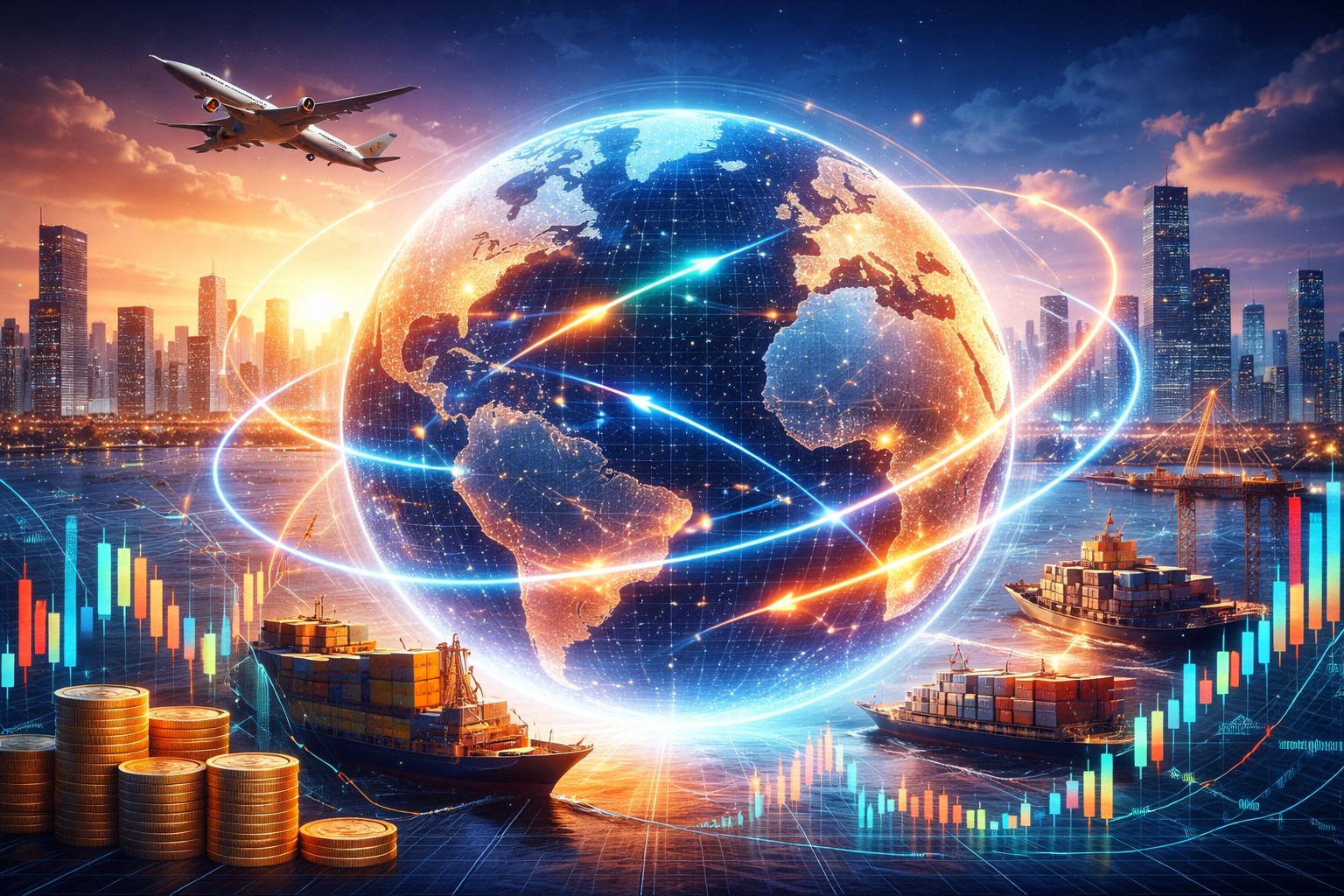
No economy works alone in the world today. Things that happen in one nation may swiftly spread to other countries, hurting corporations, investors, and regular people. The global market is a complicated web of commerce, money, technology, and human activity that connects countries.
The global economy is a complex web with many strands that are interrelated. For example, oil prices are going up in the Middle East, software companies are booming in the US, and manufacturing is changing in Asia. Not only economists and investors need to comprehend how global markets are connected to appreciate how the contemporary world works.
What Are Global Markets?
Global markets are the places where products, services, financial assets, and resources are traded throughout the world. These markets are:
- Trade marketplaces (things you buy and sell)
- Money markets (stocks, bonds, currencies)
- Markets for goods like oil, money, and farming
- Labor markets (moving to another country and outsourcing)
These markets are closely connected, thus they don’t work individually. Changes in one area can cause changes in other areas.
The Foundation of Global Market Connectivity
1. International Trade
Trade is what connects markets all around the world. Countries trade with each other to get what they don’t have and make something they are best at.
For instance:
- China makes electronics
- Saudi Arabia sells oil to other countries.
- Germany makes cars
- Brazil sends agricultural goods
When one nation sells more goods to other countries or has trade barriers, the consequences are seen across the world. For example, when supply chains are disrupted during a pandemic, it may have implications on many businesses throughout the globe.
2. Financial Markets Integration
One of the fastest-moving elements of the world economy is the financial markets. There is a connection between stock exchanges, banks, and investors.
Some of the most important aspects are:
- Investments across borders
- Foreign direct investment (FDI)
- Stock trading throughout the world
- Forex: the marketplaces where currencies are traded
A big stock market drop might make other people worry. When U.S. markets go down, investors in Asia and Europe frequently respond right away, for example.
3. Technology and Communication
Technology has made global relationships more faster and deeper.
- Real-time trading systems link investors all around the globe.
- Companies work together to manage supply chains across continents.
- The internet distributes information quickly.
Decisions taken in one nation may swiftly change markets all around the globe.
4. Multinational Corporations (MNCs)
Big businesses work in more than one country, which connects economies.
Some ways they have affected things:
- A business makes a product in one nation, sells it over the world, and then ships it to customers.
- Job growth and economic development spread throughout different areas.
- Supply chains link several countries together.
When these businesses grow or run into problems, the effects are seen in many economies.
How Global Supply Chains Connect Markets
A supply chain is the path that a product travels from its basic ingredients to the person who buys it. Supply chains are now genuinely global.
Smartphone Production
- Materials from Africa
- Parts made in Asia
- Made in China or Vietnam for assembly
- For sale in Europe and North America
If one link of this chain is broken, the whole system feels the effects. This was seen during global crises, when shipping delays and industry closures led to shortages all across the globe.
The Role of Currency Exchange
Currencies are very important for connecting markets throughout the world.
How It Works
- Countries trade with each other using many different currencies.
- The value of currencies is set by exchange rates.
- Changes in commerce, investment, and inflation are all affected by fluctuations.
For example:
A higher currency makes it cheaper for the U.S. to buy things from other countries. A lower currency may help exporters.
Currency markets are open all the time and are affected by events around the world. They are a key link between economies.
Global Commodities and Their Impact
People all throughout the globe exchange things like oil, gold, and food, which have an effect on markets all over the world.
Oil as an Example
- The cost of oil affects the cost of energy, transportation, and production.
- A supply problem makes prices go up all throughout the globe.
- Rising oil prices may cause inflation all around the world.
In the same way:
- Gold shows that the economy is not stable
- The cost of food affect the stability of the world.
These goods are shared resources that connect economies.
The Influence of Economic Policies
Decisions made by one country’s government may have a big impact on other countries’ governments.
Types of Policies
- Changes in interest rates
- Tariffs on trade
- Tax rules
- Policies on money
For instance:
- When a big economy rises interest rates, investors may move money throughout the world.
- Trade restrictions can disrupt supply chains
Central banks, particularly in big economies, have a big impact on the state of the world’s finances.
The Force Behind Globalization
The trend of globalization has made markets increasingly integrated.
Important Parts
- Agreements for free trade
- Investments across borders
- Exchange of cultures
- Moving workers throughout the world
Globalization has:
- More effective
- Costs went down
- More chances
But it has also made economies reliant on each other.
The Role of International Organizations
International organizations govern and shape global marketplaces.
Key Functions
- Making regulations for trade
- Giving money help
- Promoting teamwork
These groups assist keep markets stable and deal with problems in the global economy.
Financial Crises and Global Impact
One of the most obvious evidence that markets are related is how crises spread.
Example: Global Financial Crisis
- Started in the housing market in the U.S.
- Spread to banks all throughout the globe
- Led to a worldwide recession
This shows how closely linked financial systems are.
Emerging Markets and Their Growing Influence
More and more, developing nations are becoming crucial in global marketplaces.
- Fast expansion of the economy
- Growing middle class
- More consumption
Countries like India, Brazil, and Indonesia are changing what people want and affecting trends throughout the world.
The Role of Digital Economy
The digital economy has changed the way markets work by adding a new layer to global relationships.
Important Features
- E-commerce across borders
- Payments made online
- Work from home
- Services on the web
Businesses may now do business all across the world without being there in person, which connects markets even more.
Risks of Interconnected Markets
There are numerous advantages to global connection, but there are also hazards.
Major Risks
The effect of contagion
Problems with the economy in one nation may soon spread.
Weaknesses in the supply chain
Disruptions may have an effect on output throughout the world.
Fluctuations in currency
Changes in exchange rates affect stability.
Reliance on Global Systems
Too much dependency may make economies weak.
Benefits of Connected Global Markets
Even if there are hazards, linked markets provide a lot of benefits.
Key Benefits
- Getting products and services from across the world
- Possibilities for economic development
- Sharing new ideas and technologies
- Making jobs across boundaries
Because markets are integrated, these advantages have considerably raised living standards throughout the world.
How Global Events Affect Markets
Natural catastrophes, wars, and pandemics may all have an effect on global markets.
For example,
- Pandemic disruptions that impair supply chains
- Tensions between countries affecting oil prices
- Climate change is having an impact on farming.
These examples show how easily outside events may affect global markets.
The Future of Global Market Connectivity
The following will cause global markets to keep changing:
Technological Advancements
Trade and finance will change because of blockchain, artificial intelligence, and automation.
Sustainability Focus
Policies for green energy and the environment will change the way commerce works throughout the world.
Regionalization
Some nations could put greater emphasis on commercial relationships inside their own regions.
Digital Transformation
Digital currency and internet platforms will make relationships stronger.
Global markets are very integrated systems where economies, industries, and people are all intertwined in many ways. This complicated network is made up of trade, finance, technology, and policy choices.
Knowing how these things are connected may help us understand why things that happen in one area of the globe can have big effects on other parts of the world. Globalization has given many advantages, but it also has to be managed carefully to lower hazards.
As the globe changes, global market connectedness will only become stronger, affecting both economies and daily lives.
If you want to understand how the world works, it’s important to know how global markets are linked. This is true whether you’re a student, a company owner, or just someone who is interested in the globe.
No market is alone in a fully globalized world, and every choice matters.