
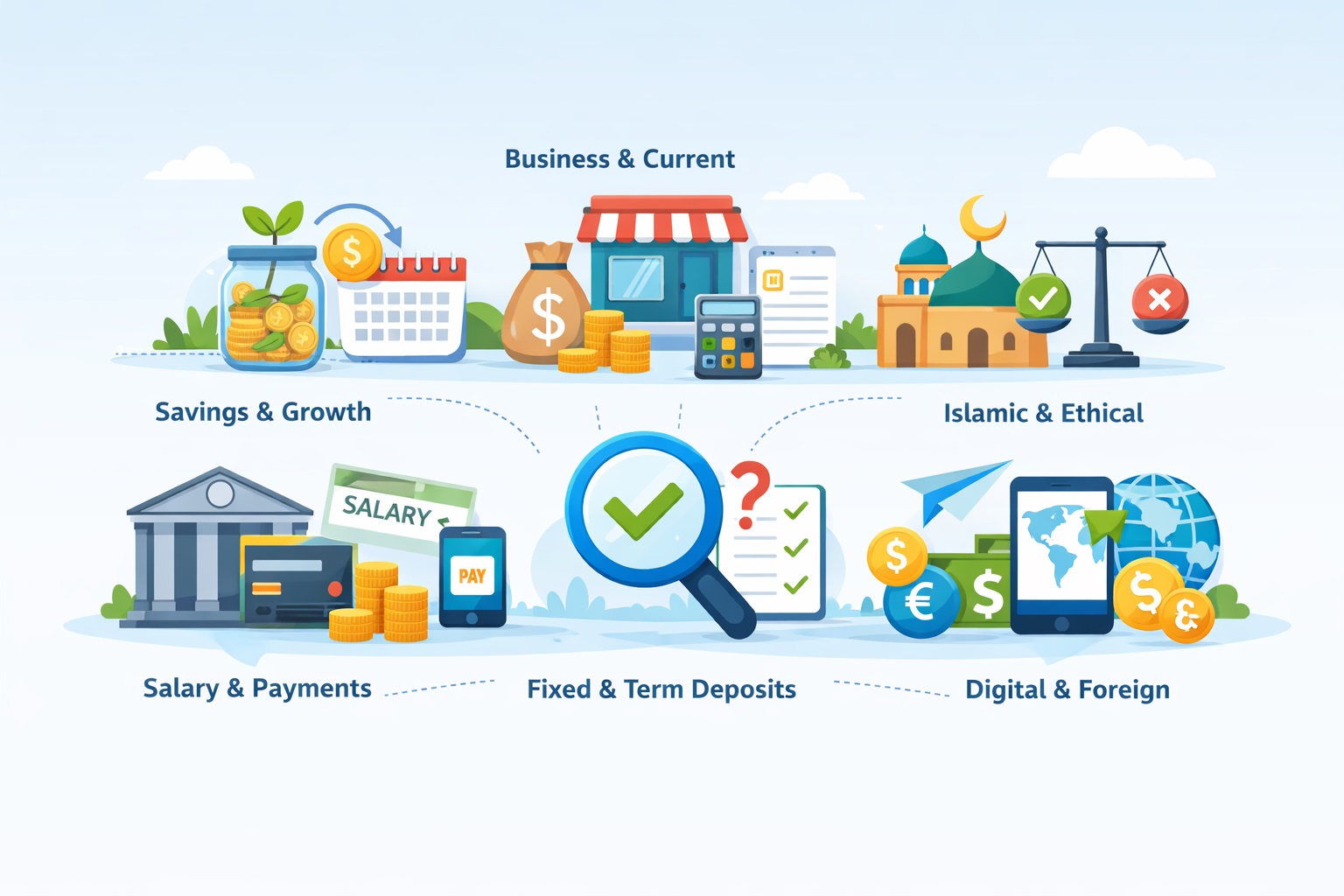
Types of Bank Accounts Explained
In today’s society, bank accounts are quite important for keeping track of your money. The kind of bank account you use has a big effect on your financial health, convenience, safety, and plans for the future, whether you know it or not.
Bank accounts are important at every stage of life, from children getting pocket money online to workers getting their paychecks and pensioners getting their pensions.
Many individuals don’t really comprehend bank accounts, even though they are important. They open one because:
- Their boss told them to
- A bank employee recommended it.
- Someone I know told me to do it.
- It was something everyone else was doing.
Because of this, individuals often:
- Pay costs that aren’t essential
- Lose out on profits
- Use the incorrect kind of account
- Have trouble managing money
- Not sure what banking phrases mean
This tutorial is meant to help you understand banking topics better, clear up any misconceptions, and provide you more information. It explains all the main types of bank accounts in simple terms, without any technical jargon or difficult financial theory. It gives real-life examples that make sense.
1. What Is a Bank Account?
When you open a bank account, you and the bank have a formal relationship in which the bank promises to:
- Keep your money safe
- Keep track of every purchase you make
- Let you put money in, take money out, and move money around
- Offer more financial services
You put your money in a bank instead than keeping it at home, where it might be stolen, lost, destroyed, or abused. The bank protects and manages your money.
The bank may then:
- Pay you interest or profit
- Give them digital access to their money
- Give out loans or money
- Help with saving and making payments
A bank account is more than just a place to save your money; it also helps you manage your finances.
It is a way to keep track of your money.
2. Why Banks Created Different Types of Accounts
Everyone has their own style of using money.
Some people:
- Spend every day
- Save every once in a while
- Make money every month
Others:
- Run companies
- Get paid from other countries
- Save for ambitions that will take a long time to reach
Some people want:
- Access right away
- High returns
- Following the rules of Islam or being ethical
If banks just had one sort of account, they wouldn’t be able to service all of these demands. That’s why banks make several types of accounts for varied financial needs.
Think of bank accounts as tools:
- You don’t chop wood with a hammer.
- You don’t use a spoon to make a hole.
In the same way:
- You don’t keep your company money in a savings account.
- You don’t utilize a set deposit to pay for things every day.
3. Main Categories of Bank Accounts (Overview)
You may put bank accounts into these groups:
- Accounts for Deposits
- Accounts for Saving
- Checking Accounts
- Accounts for Salaries
- Accounts for Fixed Deposits (Term Deposits)
- Accounts for Recurring Deposits
- Accounts for Businesses and Corporations
- Accounts with Islamic Banks
- Accounts on the Internet and in Digital Form
- Accounts in Foreign Currency
- Accounts for a Specific Purpose
Each group is there to help with a certain money concern.
4. Foundation of Banking
What Is a Deposit Account?
A deposit account is any bank account where you put money for protection. The majority of bank accounts fall into this wide group.
When you put money in:
- The bank keeps a record of it.
- The bank could utilize it to make loans.
- You still own the money.
Deposit accounts are the most important part of the banking system since they keep banks stable and running.
5. Savings Accounts
What Is a Savings Account?
People who desire to do the following may open a savings account:
- Save money in a safe way
- Make some money or interest
- Get money when you need it
It strikes a compromise between security, flexibility, and modest returns.
How a Savings Account Works
- You put money in
- The bank keeps it safe.
- The bank pays interest/profit on a regular basis.
- You can take out or move money when you need to.
Who Should Use a Savings Account?
Savings accounts are great for:
- Students in charge of their own money
- Employees in charge of pay
- Freelancers in charge of their own money
- Housewives in charge of household money
- Retirees taking care of their savings
If you deal with your own money,
Key Features of Savings Accounts
- Minimum balance is low
- Profit per month or every three months
- ATM and debit cards
- Banking online and on your phone
- Checkbook (optional)
- Payments and transfers of bills
Advantages of Savings Accounts
- A safe alternative to cash
- Simple to open and take care of
- Encourages discipline in saving
- Withdrawals that are flexible
- Well-known
Limitations of Savings Accounts
- Less money back than investments
- Limits on withdrawals
- The rates of profit may fluctuate.
- Not good for cash flow in company
Types of Savings Accounts
Regular Savings Account
A basic personal account with common features.
Student Savings Account
Made for kids with:
- No balance
- Few withdrawals
- Help in learning about money
Account for Senior Citizens’ Savings
Offers:
- Higher rates of profit
- Priority services
- Benefits for retirement
Kids Savings Account
Parents and I share an account to:
- Teach how to handle money
- Learn to save money early on.
High-Yield Savings Account
Offers:
- More profit
- More money needed in the account
6. Current Accounts (For Business and High Activity)
What Is a Current Account?
A current account is for firms who do a lot of business and have a lot of cash flow.
How a Current Account Works
- Deposits and withdrawals are unlimited.
- No interest or profit
- Minimum balance is higher
- Handling transactions every day
Who Should Use a Current Account?
- Retail shop owners
- Wholesalers
- Traders
- Corporations
- Professionals
Key Features of Current Accounts
- Unlimited transactions
- No earnings on balance
- Overdraft facility
- Cheque clearing
- Online business banking
Advantages of Current Accounts
- Operations that go smoothly
- No limits on transactions
- Image of a professional
- Moving money is easy
Disadvantages of Current Accounts
- No profit
- Fees for upkeep are higher.
- Not good for saving
7. Salary Accounts
What Is a Salary Account?
Employers set up salary accounts so that they may deposit workers’ pay directly into their accounts. This makes it easier for employees to handle their money.
- What Is a Salary Account?
- Employer pays compensation every month
- Employee may get money right away
- No balance needed.
Benefits of Salary Accounts
- No minimum balance
- Automatic credit to your income
- Debit card for free
- Paying bills is easy
If you cease being paid, the account might turn into an ordinary savings account.
8. Fixed Deposit Accounts
What Is a Fixed Deposit?
You put money into a fixed deposit account for a certain amount of time in exchange for better returns.
How Fixed Deposits Work
- Put in a lump amount
- Choose a term
- Make a certain amount of money
- Get the maturity amount
Tenure Options
- For a short time (3–6 months)
- In the medium term (1–3 years)
- Long-term (5 years or more)
Who Should Use Fixed Deposits?
- People who are retired
- Investors that are conservative
- People who plan for the future
Advantages of Fixed Deposits
- Guaranteed returns
- Not very risky
- Income that you can count on
Disadvantages of Fixed Deposits
- Money that is locked
- Penalty for early withdrawal
- Returns that are lower when adjusted for inflation
9. Recurring Deposit Accounts
What Is a Recurring Deposit?
With a recurring deposit, you may save the same amount of money every month for a long period.
How Recurring Deposits Work
- Deposit per month
- Fixed term
- Returns that are sure to happen
Best For
- People who are paid
- Students
- Saving for a goal
Advantages
- Makes you more disciplined
- Cheap
- Outcome that can be predicted
10. Business & Corporate Bank Accounts
What Is a Business Account?
A business account is used to keep track of the money a company makes and spends, as well as to make sure it follows the law.
Types of Business Accounts
Sole Proprietorship Account
A sole proprietorship account is owned by one person and is easy to understand.
Partnership Account
The Partnership Account has more than one owner and a shared power structure.
Corporate Account
Company that is registered and has established rules.
Why Business Accounts Are Important
- Records that are clear
- Following the tax laws
- Protection by law
- Trust in professionals
11. Islamic Bank Accounts
What Is Islamic Banking?
Islamic banking follows Shariah rules and doesn’t charge interest (Riba).
Core Principles
- No interest
- Sharing profits and losses
- Transactions backed by assets
- Investments that are moral
Types of Islamic Accounts
Islamic Savings Account
Returns that change dependent on profit.
Islamic Current Account
Only transactions, no profit.
Islamic Term Deposit
Based on Mudarabah or Musharakah.
Who Should Use Islamic Accounts?
- People who want to follow Shariah law
- Investors with morals
- Users who have faith
12. Digital and Online Bank Accounts
What Is a Digital Account?
You may establish and use a digital account completely online.
Benefits
- Quick setup
- No paper
- Access all the time
- Less money
Best For
- People who work from home
- Entrepreneurs who work online
13. Foreign Currency Accounts
What Is a Foreign Currency Account?
Lets you keep money in USD, EUR, GBP, and other currencies.
Ideal For
- Exporters
- Importers, freelancers, and investors from other countries
Benefits
- Different kinds of money
- Protection against losing money in exchange
14. Special Purpose Accounts
Examples
- Accounts for pensions
- Accounts for Zakat
- Accounts for trust
- Accounts that are shared
- Accounts in escrow
Each one has a distinct legal or economical purpose.
15. How to Choose the Right Bank Account (Step-by-Step)
Think about:
- What the account is for
- How often it is used
- Profit vs. access
- Personal vs. business
- Moral preferences
16. Common Banking Mistakes (Expanded)
- Making accounts without knowing
- Not paying attention to hidden fees
- Putting personal and corporate money together
- Not looking over account statements
- Closing accounts the wrong way
17. Banking Tips for Long-Term Financial Health
- Look at your account once a year.
- Use online banking
- Keep your balances low
- Read the terms carefully
- Keep your accounts in order
18. Banking Is About You
Bank accounts are not traps; they are tools.
When utilized correctly, they provide you:
Safety Ease of use Growth Control
When they are not understood, they cause:
- Stress
- Loss
- Confusion
It’s not about banks when you bank.
It’s about your money, your options, and your future.