
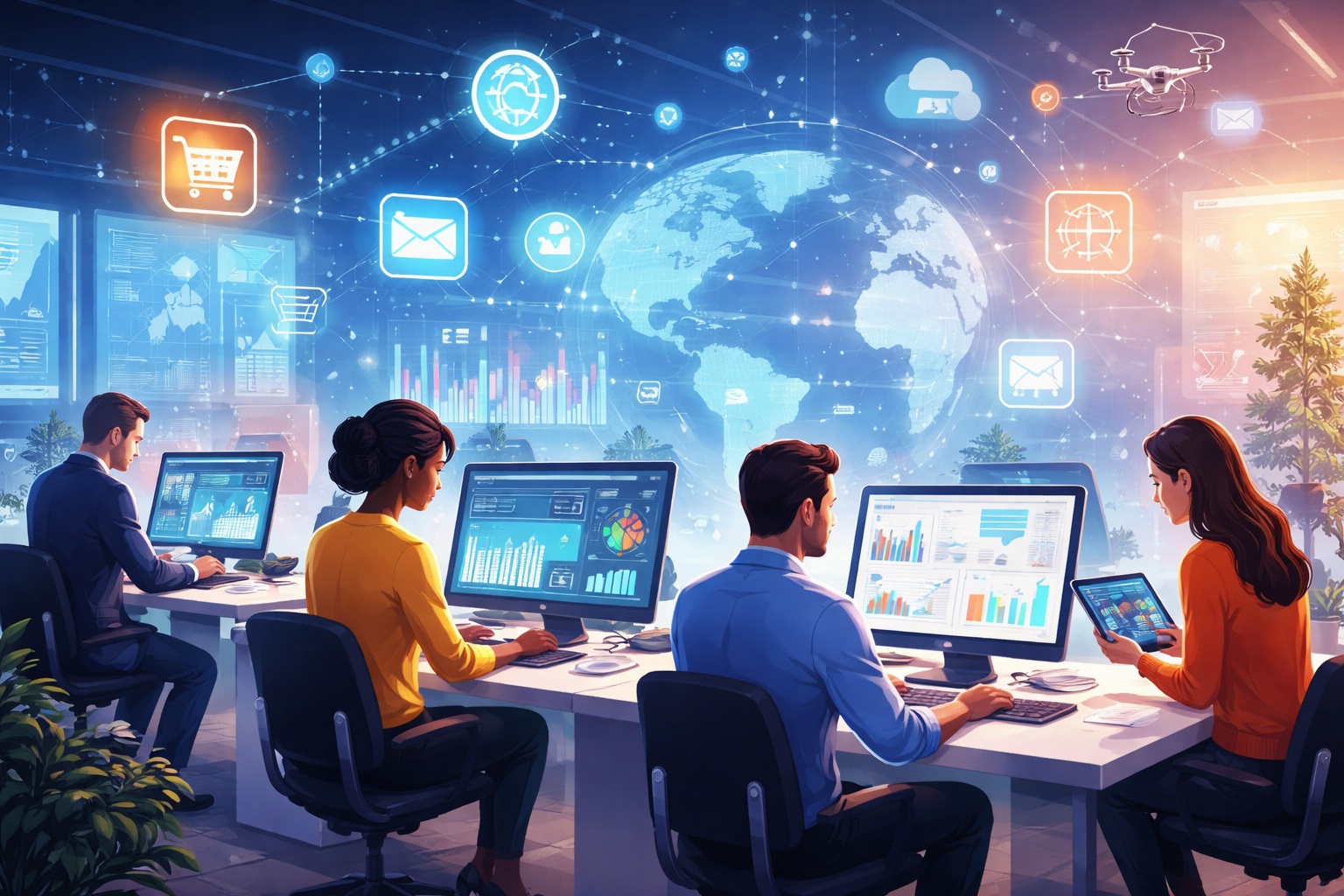
How Technology Is Changing Modern Businesses
Business today is quite different from what it was like even ten years ago. The old methods of conducting businesses, such keeping records by hand, having actual offices, working certain hours, and only reaching a small number of customers, are quickly going away. Technology-driven systems have taken over practically all of the tasks that used to be done by people.
Technology is now a part of every part of contemporary business life, from shopping groceries online to managing colleagues across the world via video conferencing. Customers want quick answers, which lets small businesses compete with big ones. Also, decision-making is moving from gut feelings to data-driven procedures.
Technology is becoming a must-have. It is no longer just a utility that sits in the background. It has become the base on which enterprises today are built.
1. Understanding Technology in Business
What Is Business Technology?
Business technology includes all the digital tools, systems, software, devices, and platforms that enable firms run more smoothly, precisely, and competitively.
This includes, but is not limited to,
- Laptops, tablets, cellphones, and computers
- Connecting to the Internet and cloud systems
- Software for businesses and apps for mobile devices
- Tools for automation and artificial intelligence
- Online banking and payment systems
- Email and video calls are examples of communication platforms.
- Tools for data analysis and reporting
In short, business technology helps organizations work smarter, not harder.
How Technology Helps Businesses
There are several ways that technology helps businesses:
- Automating tasks that have to be done over and over again saves time.
- Cutting expenses of doing business
- Making things more accurate and less likely to go wrong
- Getting to clients outside of physical limits
- Making customers happier
- Making choices that are better and quicker
A firm that knows how to utilize technology well may expand faster, change faster, and stay in business longer in markets that are competitive.
Why Technology Matters More Than Ever
Businesses nowadays have to deal with a lot of problems. They are up against:
- A lot of rivalry across the world
- Customers’ tastes change quickly
- Expectations for speed and quality are higher
- Not enough money and resources
- Always being pushed to come up with new ideas
Technology helps businesses:
- Compete with companies from across the world
- Run nonstop, 24 hours a day, seven days a week
- Easily scale processes
- Act fast when the market shifts
- Give each consumer a unique experience
In today’s world, a firm without technology is like a vehicle without gas: it won’t go very far.
2. The Evolution of Technology in Business
Past: Manual and Paper-Based Businesses
In the past, most commercial tasks were done by hand.
- There were registers and folders where records were kept.
- Letters and landline phones were the main ways to talk to one other.
- Calculators and handwritten ledgers were used in accounting.
- Marketing relied on leaflets, posters, newspapers, and radio.
These procedures took a long time, cost a lot of money, and were very likely to make mistakes. It was hard to make decisions and grow a firm.
Present: Digital and Automated Businesses
Businesses now work in a digital world:
- Digital databases keep data safe.
- You may talk to people right away using email, instant chat, and video calls.
- Accounting software does complicated math for you automatically.
- Digital marketing can reach millions of consumers in just a few seconds.
Businesses are now quicker, leaner, and more efficient than ever.
Future: Intelligent and Self-Learning Businesses
Business technology will become more intelligent and automated in the future:
- Making strategic choices will be simpler with the aid of AI.
- Smart systems will know what customers need before they do.
- Supply networks will be able to run themselves and make themselves better.
- Virtual and augmented reality will change the way we operate.
Businesses won’t simply respond to changes; they’ll be ready for them.
3. How Technology Is Changing Business Operations
Automation of Daily Tasks
One of the biggest changes in technology in business today is automation.
Businesses currently use automation to:
- Processing payroll
- Managing your inventory
- Processing orders
- Answers from customer support
- Email marketing
- Making appointments
Benefits of Automation
Automation has a lot of benefits:
- Saves a lot of time
- Lowers the number of mistakes people make
- Reduces expenses of doing business
- Makes work more productive
- Makes things more consistent
Employees may spend their time on creative thinking, problem-solving, and strategic planning instead of doing the same things over and over again when jobs are automated.
Digital Workflow Management
Digital technologies like these have taken the role of physical workflows:
- Tools for managing projects
- Software for monitoring tasks
- Sharing documents in the cloud
- Platforms for working together in real time
These solutions make it possible for teams to function well from anywhere in the globe. Working from home, which used to be rare, is now a normal way for businesses to do business.
4. Technology and Business Communication
Faster, Smarter, and Global Communication
Technology has changed how businesses talk to one other:
- Emails took the role of regular letters.
- Video calls took the place of many in-person meetings.
- Instant texting made it faster to make decisions.
Now, businesses may easily talk to:
- Workers
- Customers
- Suppliers
- Partners from other countries
Distance is no longer a problem for working together.
Remote and Hybrid Work Culture
Technology has made it possible to operate in several ways:
- People work from home or in shared workspaces.
- Companies recruit people from all around the world.
- Flexible hours let you combine work and life.
This change has permanently changed how people work together, which has led to more productivity and happier workers.
5. How Technology Is Transforming Customer Experience
Personalized Customer Interaction
Businesses now employ technology to get to know their consumers better.
They keep track of:
- How people browse
- History of purchases
- Likes and dislikes
This lets firms offer:
- Recommendations that are unique to you
- Personalized deals
- Content that is relevant
People don’t want generic experiences anymore; they want everything to be tailored to them.
24/7 Customer Support
Technology makes it possible to get help 24 hours a day, seven days a week through:
- Bots
- Help desks that work on their own
- Response systems that use AI
Customers get help right away, which builds trust, loyalty, and satisfaction.
6. Technology and Digital Marketing
Shift from Traditional to Digital Marketing
Digital channels are taking the role of traditional marketing tools including newspapers, billboards, and flyers:
- Marketing on social media
- Marketing using search engines
- Email marketing
- Marketing with content
With digital marketing, companies can reach particular groups of people, see how well their efforts are doing, and make changes to them right away.
Search Engine Optimization (SEO)
SEO benefits companies:
- Show up in search engines
- Get natural traffic
- Make yourself visible for a long time
Technology gives us the tools to:
- Researching keywords
- Analytics for websites
- Tracking performance
- Improving content
SEO is becoming a key part of growing an internet company.
7. E-Commerce and Online Business Models
Rise of Online Selling
Technology has made it possible for everyone to do business online.
Now businesses can:
- Sell things all across the world
- Run without having shops
- Cut down on personnel and renting expenses
- Get bigger quicker
E-commerce has revolutionized how people shop for good.
Digital Payments and Financial Technology
Some of the most common modern payment methods are:
- Banking online
- Wallets on phones
- Payments without contact
- Transfers between countries
These systems provide you:
- Quickness
- Safety
- Convenience
- Access from anywhere in the world
Money travels quicker than it ever has before.
8. Technology and Data-Driven Decision Making
Importance of Business Data
Data is perhaps the most important asset for businesses.
Businesses gather information on:
- How well sales are doing
- How customers act
- Traffic to the website
- How well marketing works
Turning Data into Insights
By doing the following, technology turns raw data into useful insights:
- Finding patterns and trends
- Guessing what customers will want
- Making tactics better
Making choices based on facts is more accurate, sure, and lucrative.
9. Artificial Intelligence in Modern Business
What Is Artificial Intelligence?
Artificial intelligence is the term for computers that can:
- Learn from information.
- Look at the information
- Make guesses
- Do smart things
How Businesses Use AI
AI is used a lot for:
- Chatbots for customer service
- Finding fraud
- Suggestions for products
- Forecasting demand
- Improving the process
Benefits of AI
- Making decisions faster
- More accurate
- Lowered expenses of doing business
- Better experiences for customers
AI isn’t just something that will happen in the future; it’s already changing how businesses work.
10. Cloud Computing and Business Flexibility
What Is Cloud Computing?
Cloud computing lets companies store data and operate their businesses online, so they don’t require physical servers.
Benefits of Cloud Technology
- Less expensive infrastructure
- Access from anywhere
- Simple to grow
- Better security
- Continuity of business
Cloud computing makes it easy to operate from anywhere and grow your business throughout the world.
Cybersecurity and Business Protection
Growing Cyber Risks
As firms become digital, they also take on more risks:
- Data leaks
- Attacks on computers
- Stealing someone’s identity
- Fraud on the internet
Importance of Cybersecurity
Companies use technology to protect themselves with:
- Encryption
- Firewalls
- Authentication using more than one factor
- Updates for security on a regular basis
Cybersecurity is no longer a choice; it’s a must for staying alive.
11. Technology and Human Resources (HR)
Digital HR Management
HR technology takes care of:
- Hiring
- Payroll
- Being there
- Reviews of performance
Online Recruitment
Businesses currently employ by using:
- Job boards
- Interviews on video
- AI tools for screening
This makes recruiting faster and helps you find better candidates.
12. Technology and Business Innovation
Faster Product Development
Businesses may do the following using technology:
- Design on a computer
- Quickly test concepts
- Get feedback from customers
- Get items out there quicker
Innovation Through Technology
Now, new ideas emerge from:
- Online services
- Smart answers
- New ways of doing business
Technology makes it easier to be creative and try new things.
13. Impact on Small Businesses and Startups
Level Playing Field
Small enterprises may do the following using technology:
- Compete with big businesses
- Get in touch with people all across the world
- Work well
- Less money needed to start
With technology:
- Offices are not required
- Marketing doesn’t cost much
- You can go to the tools.
This has caused entrepreneurship to grow over the world.
14. Technology and Globalization
Borderless Business World
Technology gets rid of limits based on where you live:
- Customers from other countries
- Teams that work from home
- Payments throughout the world
Businesses may grow without having to move.
15. Challenges of Technology in Business
Learning and Adaptation Challenges
- Lack of skills
- Costs of training
- Not wanting to change
Technology Dependence
Too much dependence on technology may cause:
- System failures
- Loss of data
- Less engagement with others
Using it in a balanced way is important.
16. Ethical and Social Impact of Technology
Job Transformation, Not Job Elimination
Technology alters employment responsibilities:
- Some occupations go away
- New positions come up
- Skills change
It is important to keep learning.
Data Privacy and Responsibility
Companies must:
- Take good care of consumer data.
- Use technology in a moral way
- Gain people’s confidence
For long-term success, it’s important to use technology in a moral way.
17. Future of Technology in Business
Emerging Trends
- Decision systems powered by AI
- Automation at a higher level
- Workspaces in the cloud
- Predictive analysis
Preparing for the Future
Businesses need to:
- Stay flexible
- Be smart with your money
- Teach workers
- Accept that you will always be learning.
18. How Businesses Can Adapt to Technological Change
Practical Steps
- Know what businesses really need
- Choose the right technology
- Give teams the right training
- Focus on what the consumer wants
- Keep an eye on things and make them better all the time
Technology should help people, not take their place.
19. Role of Leadership in Digital Transformation
Visionary Leadership
Leaders need to:
- Support new ideas
- Help with learning
- Accept change
Building a Tech-Friendly Culture
Just having tools isn’t enough. Company culture is very important for success.
20. Technology Is a Tool, Not a Replacement for Humanity
Despite the advancements in digital technology:
- Trust is still important
- Relationships are still important
- Ethics are still important.
Technology makes human work easier, but it doesn’t replace it.
21. Technology as the Heart of Modern Business
Every facet of modern businesses has been revolutionized by technological advancements. The way in which companies operate, communicate with one another, market themselves, sell items, and grow has been altered as a result of this. Automation and artificial intelligence, digital marketing, and collaboration with individuals from all over the globe are all examples of how technology dictates the success of businesses in today’s environment.
However, technology by itself is not the answer to the problem. The actual power is in the manner in which individuals make use of technology to address problems, make things better, and act in a manner that is beneficial to customers.
In the current digital world, organizations that make use of technology in a manner that is intentional, adaptable, and responsible will not only be able to survive, but they will also be able to perform successfully.