
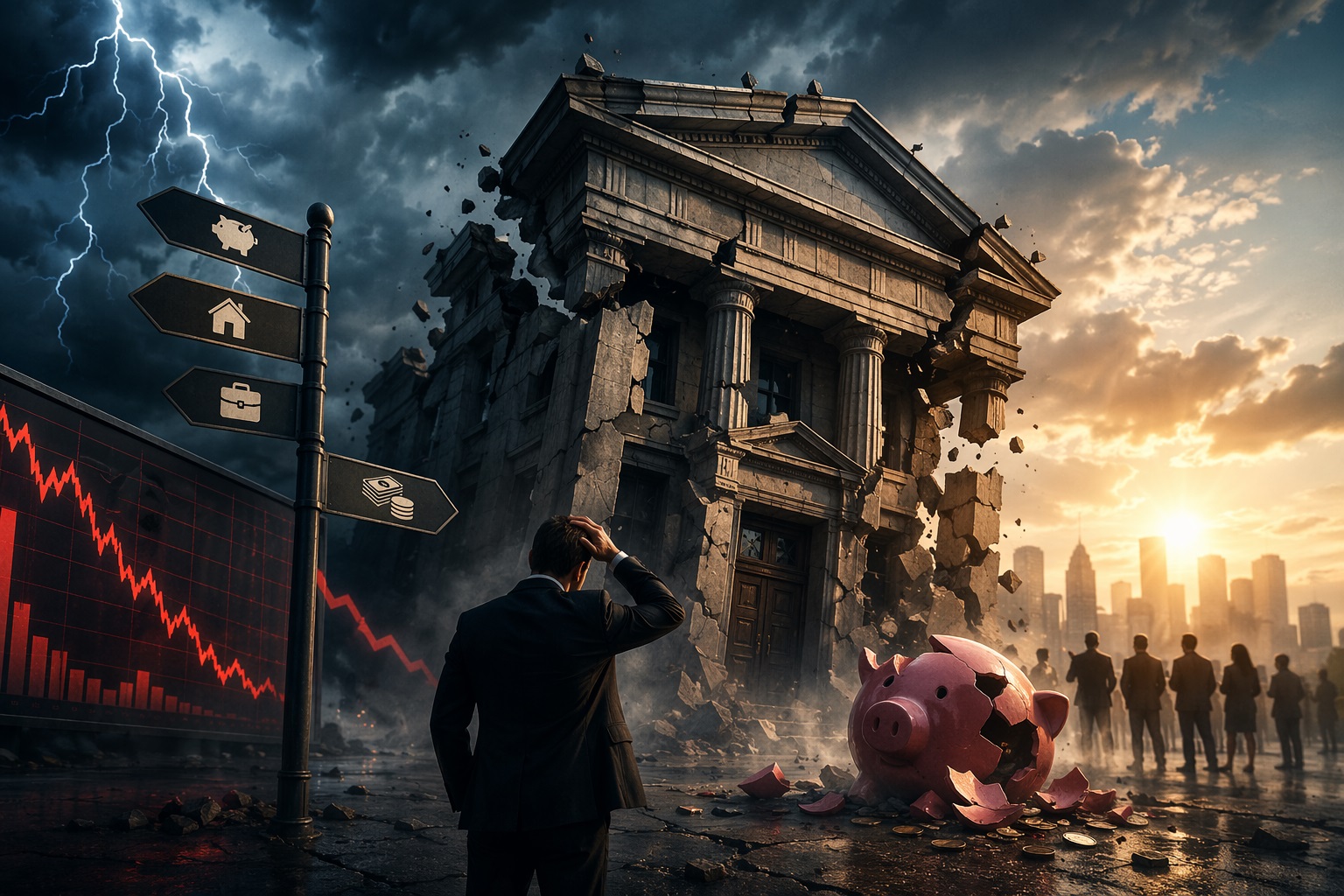
They protect our money, make loans available to us, provide assistance to businesses, and ensure that the whole financial system functions in an effective manner. However, what happens in the event that a bank ceases operations?
The history of the world reveals that bank failures occur more often than most people assume they do. This may give the impression that bank failures are uncommon. It is possible for the collapse of banks to result in widespread financial instability, economic downturns, and panic, ranging from global financial crises to the bankruptcy of local banks itself.
1. What Is a Bank Failure?
When a bank fails, it means that it can no longer satisfy its commitments to depositors and creditors. In plain words, the bank either runs out of cash or becomes so financially unstable that it can’t safely keep doing business as usual.
Regulators need to act fast to avoid a major collapse in the financial system and the wide-ranging effects it would have on the economy.
Key Reasons Why Bank Failures Occur
These are the key reasons why banks fail:
1. Excessive Bad Loans
For instance, a bank generates money from the interest on a $100,000 loan to a firm. But if a lot of borrowers don’t pay back their loans (called loan defaults), the bank loses money. Over time, these kinds of things eat away at the bank’s capital and make it go bankrupt.
2. Rapid Withdrawal of Deposits (Bank Run)
If consumers lose faith in a bank, they may all try to take out their money at the same time. This is known as a bank run. Banks may not be able to accommodate these unexpected withdrawal requests since they don’t retain all of their deposits in cash.
3. Heavy Financial Losses
Banks also put money into the stock market. The bank’s financial stability may be harmed by big losses from bad investments, market collapses, or rapid economic shocks.
Role of Regulators
Financial authorities step in when a bank is about to collapse in a big way. They may do things like:
- Taking control of the bank
- Combining it with a stronger organization
- Selling off its assets
- Insurance plans that protect depositors
Regulators need to do something to soothe people down and stop panic from spreading in the financial system.
2. How Banks Actually Work
To understand why banks fail, you need to know how they function every day.
Core Functions of Banks
Banks are very important to the economy because they do three main things:
1. Accepting Deposits
Customers put money into savings accounts, current accounts, or fixed deposits. The bank is now responsible for this money.
2. Borrowing Money
People, corporations, and governments may borrow money from banks that they have deposited. The bank owns these loans and makes money from the interest they charge.
3. Making Money
The net interest margin is the difference between the interest banks make on loans and the interest they pay on deposits. This is how they make money.
The Key Idea: Fractional Reserve Banking
Fractional reserve banking is one of the most significant parts of contemporary banking.
This is how it works:
- Banks only hold a modest amount of their deposits as cash reserves.
- Most of the money is either given out or put into investments.
For instance, a bank may only maintain $100 of the $1,000 it gets in deposits as reserves and lend out the other $900.
Why This System Is Important
Fractional reserve banking may help the economy thrive, but it also makes it more vulnerable.
Risk of Liquidity
If a lot of consumers want their money at the same time:
- The bank could not have enough money on hand
- It can have trouble swiftly turning loans or investments into cash.
Even if the bank is technically solvent (meaning its assets are more than its liabilities), this difference between the amount of cash available and the amount of cash that people want to withdraw might cause a crisis.
3. Big Reasons Why Banks Fail
Banks don’t usually fail for just one cause. Instead, they are frequently the outcome of many dangers that are all happening at the same time.
1. Poor Risk Management
If banks don’t manage risks well, they might take on too many risks and become unstable, which could lead to their failure.
When banks collapse, they
- Give loans to high-risk borrowers without doing the right checks
- Put a lot of money into markets that are unstable or risky
- Don’t pay attention to early warning indications like growing default rates.
Bad decisions made by management might slowly hurt the bank’s finances.
2. Economic Recession
Banks are hurt directly and badly by an economic downturn.
When things are bad:
- Businesses close or cut down on their work
- More people are out of work
- People have a hard time paying back debts
Because of this:
- More people are defaulting on loans
- Bank income goes down
- The quality of assets becomes worse.
This condition might cause banks to collapse if it lasts too long.
3. Running to the Bank
A bank run is one of the most hazardous and quick ways for a bank to collapse.
How It Works
- People start to talk about or worry about how stable a bank is.
- People hurry to take out their money
- Panic grows as more individuals join in.
- The bank runs out of cash
Even banks that are in good shape might fail if a lot of people take their money out at once out of fear.
4. Mismatch Between Assets and Liabilities
Banks work by keeping their assets (like loans and investments) and their liabilities (like client deposits) in balance.
When there is a mismatch, it happens when
- Assets are things that you own for a long time, such loans that last 10 to 20 years.
- Liabilities are things you owe that are due soon (such deposits that may be taken out at any moment).
The Issue
- If a lot of depositors want cash at once:
- The bank can’t swiftly turn long-term assets into cash.
- This makes the liquidity issue worse.
Banks need to be very vigilant about these kinds of imbalances because they constitute a structural risk.
5. Fraud and Bad Management
Fraud and bad management are two internal problems that may really hurt a bank.
Common Problems Include
- Insiders stealing money
- Changing or lying about financial documents
- Investments that are careless or not allowed
These activities make things less clear, lie to stakeholders, and may even lead to financial failure.
6. Interest Rate Changes
Changes in interest rates have a big effect on a bank’s financial soundness.
Effects of Rising Interest Rates
- The value of fixed-rate assets that are already there, like bonds, goes down.
- Customers have to pay more to borrow money.
- There may be less demand for loans.
Effects of Falling Interest Rates
- The profit margins are progressively reverting to the level they were at previously, which is happening over the course of time.
- The act of making investments results in a decrease in profits once they have been made.
Changes in interest rates have the potential to result in losses and contribute to a reduction in the bank’s stability in the event that they occur without prior warning or in a way that is unanticipated. This happens as a consequence of the fact that there is a chance that changes in rates could take place independently of any explanation that has been provided in advance.
7. Shocks from Outside
Another kind of risk that banks are exposed to is the possibility of events that are beyond their ability to control.
As some instances, here are several:
- Consequences of the global financial crisis
- Alterations in policy or instability in political systems
- Pandemics such as the COVID-19 virus
- Natural disasters that occur
As a result of these occurrences, the economy may have difficulties, the situation may become more ambiguous, and the financial sector may experience stress.
4. What Happens When a Bank Goes Under?
To be financially savvy, manage your risks, and keep your money safe, you need to know what happens when a bank fails. It doesn’t happen all at once when a bank collapses; it happens in steps with the help of regulators, financial systems, and client protection measures.
Step 1: Signs of Trouble Start to Show
When analyzing the period of time that precedes the collapse of a financial institution, there are a number of signs that must to be taken into account. There is a possibility that authorities, investors, and consumers may become aware of these signs as a consequence of the possible significance that they may have.
Falling Profits
When the earnings of the bank continue to decline, it is an indicator that the financial institution is having difficulty creating money via the delivery of services, investments, or loans. This is because the bank is having problems producing money.
Rising Bad Loans (Non-Performing Loans)
In the event that borrowers fail to repay their loans, the bank’s financial situation deteriorates. Capital reserves and liquidity are both reduced when default rates are high.
Liquidity Shortages
To be able to process withdrawal requests, financial institutions need to have sufficient cash or other liquid assets on hand. It is referred to as a liquidity crisis when an excessive number of customers withdraw money at the same time or when the bank is unable to quickly convert assets into cash.
In the event that the bank does not effectively handle the concerns, these warning flags signal the possibility of financial difficulties.
Step 2: Government Intervention
When there is an increase in hazards, the authorities of the government and the central banks intervene to maintain stability and prevent any damage to the system.
For the most part, they will do,
Inspection and Auditing
Regulators look carefully at the bank’s financial records, lending portfolios, and risk exposure.
Operational Restrictions
The bank may not be able to provide out new loans, pay dividends, or grow its business.
Corrective Measures
To bring back stability, the authorities may ask for restructuring, more funding, or changes in management.
At this point, the aim is to keep everything from falling apart and keep the whole financial system safe.
Step 3: Bank Closure
There is a possibility that the authorities may opt to close down the financial institution if the situation of the bank continues to worsen even after they have taken action.
This means:
Official Closure
The bank is declared bankrupt and stops doing business as usual.
Regulatory Takeover
When a bank fails, its assets and liabilities are taken over by a financial institution or a government agency.
When banks close their doors, people take efforts to prevent themselves from becoming too worried, and the changeover is quite simple.
Step 4: Deposit Protection
The provision of insurance on deposits made by customers is one of the most important precautions that contemporary banking systems have put in place to protect the money of their customers.
Protection for Small Depositors
Most nations have national deposit insurance plans that protect savings up to a certain amount.
Fast Reimbursement
Most of the time, clients who are eligible get their protected money within a few days or weeks.
This approach is meant to maintain the public’s trust and stop bank runs.
Step 5: Asset Liquidation or Sale
After the bank goes out of business, its assets are utilized to pay back depositors and creditors.
Asset Liquidation
The bank sells loans, assets, and investments to get money back.
Transfer to Another Bank
In certain circumstances, a healthy bank buys the bankrupt bank’s assets and debts, which keeps things running smoothly for clients.
For depositors who are not covered by insurance, this is the stage at which the amount that is most likely to be recovered is established. Those depositors who are not insured by insurance are particularly vulnerable to the scenarios described below.
Step 6: Customer Impact
Customers may still have problems from time to time, even with precautions in place.
Limited Access to Funds
During the transfer, accounts may be temporarily frozen.
Payment Delays
Payments like salary, bills, or transfers may take longer than usual.
Uncertainty
During the procedure, customers typically feel anxious and confused.
But regulatory regimes try to make things less annoying and save money.
5. What Happens to Your Money?
Your money’s protection is the most crucial thing to think about when a bank fails. The result depends on whether or not your savings are protected.
Insured Deposits
If your money is within the insured limit:
Full Protection
You will get your money back.
Quick Access
In a typical scenario, payments are processed within a few days or weeks.
Deposit insurance protects the great majority of persons who have individual accounts because they have deposit insurance. This is because deposit insurance is available to them. This is because part of their savings are protected by insurance, which also explains why this is the case.
Uninsured Deposits
If your deposits are more than the insured limit:
Partial Risk
You might lose part of your money.
Recovery Depends on Asset Sales
The amount you get back depends on how much money the government can make by selling the bank’s assets.
This risk is usually higher for big depositors, enterprises, and investors.
Loans and Debts
Your debts don’t go away just because a bank fails.
Repayment Still Required
You have to keep paying off your loan, mortgage, or credit line.
Loan Transfer
Your loan can be sold or moved to an other bank or financial organization, which will then take care of your account.
If you don’t pay back your loan, you might be in trouble with the law, even if the bank that gave you the loan has gone out of business.
6. Impact on the Economy
When banks fail, it affects more than just their clients. It causes problems with lending, investing, and the entire stability of the economy. Here’s how:
1. Loss of Confidence
In the event that a bank is unable to fulfill its responsibilities, individuals lose faith in the whole financial system.
- “Bank run” refers to the situation in which individuals rush to withdraw money from other banks.
- The increasing level of anxiety leads to an increase in the economy’s level of instability.
In the banking industry, confidence is of utmost importance, and the loss of it may lead to a great deal of troubles.
2. Credit Crunch
Banks are important because they lend money to people and companies.
- The lending process slows down or stops.
- It is hard for businesses to get loans
- Less money for investments
This kind of problem is called a credit crunch, and it may slow down economic development a lot.
3. Job Losses
Whenever businesses are unable to get credit:
- The expansion plans have been put on hold.
- Reductions in the costs of operating the company
- There is a possibility that people may lose their employment.
Due to this circumstance, a greater number of individuals are losing their employment and spending less money, which further deteriorates the state of the economy.
4. Market Panic
When financial institutions fail to meet their obligations, the markets often respond in a substantial manner.
Stock Market Declines
People sell stocks because they are scared and don’t know what to do.
Volatility Increases
Prices change quickly
Investor Confidence Drops
Long-term investment mood drops
Panic in the market may spread swiftly and impact more than just banks.
7. Government Response to Bank Failures
When banks fail or are in serious financial trouble, governments and regulatory bodies step in to defend the economy, keep the public’s trust, and stop systemic catastrophes from happening. These measures are quite important since banks are very related to companies, people, and the financial markets.
1. Deposit Insurance
Governments utilize deposit insurance to keep people from panicking during banking crises.
- It makes sure that anyone who put money in will get it back up to a specific amount.
- This makes it less likely that a bank run would happen, when customers rush to take out money.
- It makes people trust the financial system more, particularly small savers.
The Federal Deposit Insurance Corporation (FDIC) in the United States, for example, protects deposits up to a certain amount for each account holder. A lot of nations use systems like this to preserve their residents’ money.
2. Bailouts
When the government helps a bank that is having trouble with money, it is called a bailout.
Purpose of Bailouts
- Stop large banks from completely falling apart
- Make the whole financial system more stable
- Don’t let it spread to other banks and businesses.
Governments might:
- Put money into the bank
- Give out loans in an emergency
- Buy dangerous or poisonous assets
Bailouts are contentious, however, since they could encourage banks to take too many risks by making them think the government would help them if they do.
3. Mergers and Acquisitions
Another usual answer is to combine a failing bank with a stronger one.
How it Works
- A bank that is doing well buys the failing bank.
- Customers can still go to their accounts without any problems.
- The stronger bank takes on debts and runs the business.
A lot of people like this method better because:
- It doesn’t make people panic.
- Keeps financial services going
- Lessens the necessity for the government to spend money directly
4. Nationalization
In the most severe instances, the government may take over a bank that is failing.
Key Features
- The government assumes ownership of the property.
- It is still the state that is in control of the operations of banks.
- When there is no private buyer, this is the method that is used.
This step is generally just for a short time before the following one is taken:
- The bank gets back on its feet.
- You may sell it back to the private sector.
8. Famous Bank Failures in History
Learning from past bank failures helps us understand how financial crises start and what the government does about them.
1. Global Financial Crisis (2008)
The Global Financial Crisis was one of the greatest financial catastrophes in recent memory.
Key Impacts
- The failure of big banks
- The housing market crashed.
- A lot of people are losing their jobs all across the globe.
- Recession throughout the world
The crisis was mainly caused by:
- Lending practices that are risky
- Financial tools that are hard to understand
- Poor regulation
2. Lehman Brothers Collapse
The collapse of Lehman Brothers was a key moment in the 2008 crisis. It set off a chain reaction that spread fear and uncertainty across the world’s financial markets.
What Happened
- In September 2008, the bank went insolvent.
- It was one of the biggest banks in the world for investments.
Consequences
- Panic in financial markets throughout the world
- Big drops in the stock market
- Credit markets stopped working
This occurrence showed how closely linked the world’s financial systems are.
3. Silicon Valley Bank (2023)
The fall of Silicon Valley Bank is a recent illustration of how rapidly banks may go out of business these days.
Key Causes
- Quick withdrawals by depositors
- Bad ways to handle risk
- A lot of fluctuations in interest rates
Lessons Learned
- The quickness of digital banking makes bank runs more likely.
- Risk management is very important in markets that change quickly.
9. Bank Runs Explained in Simple Terms
People take out a lot of money from a bank at the same time because they are afraid the bank will go bankrupt.
An Easy Example
- 100 individuals put money in a bank
- The bank only retains 10% of its money in cash (fractional reserve banking).
- The remainder is given to others who need to borrow it.
Now picture this:
Fifty individuals suddenly want their money back.
What Happens
- The bank doesn’t have enough cash on hand
- It can’t handle all requests for withdrawals.
- Customers are starting to panic.
- More individuals are rushing to take out money.
Fear is one of the factors that may have contributed to the failure of a financial institution, in addition to the fact that the institution did not have sufficient financial resources within its possession.
10. How Bank Failures Affect Ordinary People
The collapse of a bank is not only a tale that is reported in the media; it also has real-world ramifications that are experienced on a daily basis by both people and private enterprises.
1. Savings Risk
Even with insurance on deposits:
- Only a little quantity is safe
- People with big accounts can lose money.
This makes things unclear for those who have a lot of money saved up.
2. Business Disruptions
Businesses are hurt right away when banks collapse.
Possible Effects
- Company money lost
- Not being able to pay workers or suppliers
- Operations were stopped
Small and medium-sized businesses are particularly at risk.
3. Loan Issues
People who borrow money may feel confused and unsure.
Common Problems
- Changes in who owns the loan
- New terms for paying back
- Lack of communication
This might make it hard to prepare for both personal and corporate budgets.
4. Emotional Stress
Unstable finances might hurt your mental health.
Common Reactions
- Worrying about savings
- Being afraid of losing money
- Worrying about money in the future
Bank failures have the potential to set off a domino effect that has ramifications not just for the economy but also for the mental health of people.
11. How to Protect Yourself from Bank Failures
Bank failures don’t happen very often, but they may have big effects on your finances if you’re not ready. Taking precautions ahead of time will help protect your funds and keep your finances stable, even when the economy is unstable.
1. Diversify Your Money
Diversification is one of the best ways to do this. Don’t put all of your money in one bank account or financial institution. Instead:
- Put your funds in more than one bank.
- Use a combination of financial tools, such savings accounts, fixed deposits, and investments.
- You may want to keep part of your money in something other than banks, such gold or government bonds.
This lowers the chance that you will lose all of your money if one bank goes down.
2. Stay Within Insurance Limits
In the event that a bank fails to do business, the majority of countries provide deposit insurance to protect its customers. By way of illustration, the Deposit Protection Corporation in Pakistan safeguards funds up to a certain sum for every individual depositor at every bank establishment.
To keep safe:
- Make sure that your deposits in each bank are below the insured limit.
- If you have a lot of money saved up, open accounts at more than one bank.
- Know what kinds of accounts are included
This means that even if a bank goes out of business, you will get your money back up to the insured amount.
3. Choose Strong Banks
It’s quite important to choose a bank that is financially solid. Look for schools with:
- Agencies give them high credit ratings
- A lengthy history of good performance and a good reputation
- Strong cash reserves and profits
In general, well-established banks are better able to weather economic downturns.
4. Monitor Financial News
If you stay educated, you’ll be able to respond promptly if you see warning signals. Look out for:
- Changes in the economy
- News regarding stress in the banking industry
- Reports of problems with cash flow at several banks
Organizations like the State Bank of Pakistan can provide you reliable information that may help you spot such problems early on.
5. Keep Emergency Cash
If your bank goes down, having some of your emergency money in cash at home helps make sure you can get to it right away. This might include:
- Cash at home (in a safe area)
- Assets that are easy to get to
- Money set aside for short-term emergencies
This plan makes sure you can pay for important things even if your bank services are momentarily down.
12. Warning Signs of a Weak Bank
For example, if a bank’s stock price keeps going down, it might be an early clue that the bank is having money problems. These are some signs that a bank is having a hard time:
Declining Stock Price
A bank’s stock price going down all the time may indicate that investors are losing faith in the firm.
Negative News Coverage
A lot of claims of money problems, litigation, or government action are bad signs.
Poor Financial Reports
Low profitability, growing indebtedness, or shaky balance sheets are signs of instability.
High Loan Defaults
The bank’s financial condition becomes worse when a lot of borrowers don’t pay back their debts.
If you know what to look for, you can intervene before a situation becomes worse.
13. Difference Between Bankruptcy and Bank Failure
To be financially smart, you need to know the difference between these two words.
Bank Failure
- The collapse of a bank occurs when the institution is unable to fulfill its obligations to financial depositors.
- It is the responsibility of regulators, the same as it is of central banks.
- Maintains the security of depositors while also ensuring the stability of the economy
- The process of transferring or reorganizing assets to another financial institution
Bankruptcy
- A legal procedure in which a firm says it can’t pay its bills
- Not only banks, but also businesses and people.
- Handled by courts
- Creditors may get their money back by selling assets.
Bank failure is a controlled way to deal with problems, whereas bankruptcy is a judicial procedure that applies to bigger groups.
14. Psychological Impact of Bank Failures
Bank failures aren’t only bad for business; they also make people feel and behave in powerful ways.
Fear and Panic
Fear spreads swiftly when people learn about a bank that is going out of business. These kinds of anxieties may lead to:
- Bank runs and panic withdrawals
- Sudden loss of faith in banks and other financial organizations
Herd Behavior
People typically do what others do instead of making their own choices. individuals may take money out of their accounts if they observe other individuals doing so, even if there is no apparent sign of danger.
Loss of Trust
Repeated failures may make people lose faith in the whole financial system, which can lead to:
- Less money in deposits
- People are more likely to want cash or other possessions.
At both the individual and systemic levels, managing these psychological repercussions is very important for maintaining financial stability.
15. Digital Banking and Modern Risks
Digital banking has made things easier, but it has also brought new threats that clients need to be aware of.
Faster Withdrawals via Apps
You may send money right away using mobile applications and internet banking. They are easy to use, but they also mean:
- It may happen a lot quicker than bank runs
- You may take out a lot of money in a matter of minutes.
Instant Panic Through Social Media
Twitter (now X) and Facebook are two platforms that may quickly disseminate misinformation, which can lead to:
- False information concerning the stability of banks
- People became panicked
Cybersecurity Threats
Cyber dangers like these may affect digital banking systems:
- Attacks that use phishing
- Data leaks
- Transactions that weren’t allowed
To be safe:
- Set up two-factor authentication and use secure passwords.
- Don’t click on links that seem fishy
- Check your bank statements on a regular basis.
16. Are Bank Failures Becoming More Common?
When banks collapse, they typically make the news, which makes it seem like they are happening more and more. But the truth is a little more complicated. The number of bank failures may not be going up, but they are occurring quicker and having a bigger effect because of current financial systems.
Why Failures Feel More Frequent
1. Speed of Information
The rapid dissemination of news in today’s digital age is facilitated by social media and financial websites. Depositors may experience dread as a result of the rapid spread of a rumor or concern over the survival of a bank.
2. Rapid Withdrawal Systems (Digital Bank Runs)
In days gone by, customers were required to physically visit the banks. Now, banking enables you to do transactions via the internet in a short amount of time. This indicates that thousands, and potentially millions, of customers may withdraw money at the same time, which accelerates the deterioration of the bank’s financial situation.
3. Interconnected Financial Systems
In a significant sense, contemporary banks are connected to global financial networks. The difficulties that occurred at one bank may quickly spread to other banks, which would result in a domino effect that would affect the whole financial sector.
17. The Role of Central Banks
Central banks are very important for keeping the economy stable and preventing big economic problems from happening. The Federal Reserve, the European Central Bank, and other institutions are the main parts of the financial system.
How Central Banks Protect the Economy
1. Providing Emergency Funds (Lender of Last Resort)
When banks are in trouble, central banks provide them emergency liquidity. This prevents short-term liquidity difficulties from evolving into full-blown failures.
2. Stabilizing Financial Markets
In times of crises, central banks step in by
- Purchasing government bonds
- Adding liquidity to markets
- Helping important financial institutions
These activities bring back trust and lower terror.
3. Controlling Interest Rates
Central banks may change borrowing and spending by changing interest rates:
- Lower rates make people want to do business.
- Inflation is kept in check by higher rates.
This balance helps keep things from becoming bad enough that banks collapse.
Why This Matters
Central banks are like a safety net that keeps little problems from turning into big ones.
18. Long-Term Effects of Bank Failures
Bank failures may have long-lasting effects that go beyond only the financial industry.
Major Long-Term Impacts
1. Economic Slowdown
In the event that a bank goes out of business, they will cease lending. There is a significant difficulty in obtaining funds for businesses, which results in the following:
- A reduction in the amount of money invested
- Losing one’s job
- A more gradual expansion of the economy
2. Regulatory Changes
Governments typically react by making the rules stricter:
- More money is needed
- Better monitoring of risks
- Stronger rules for following the rules
These steps make banking safer, but they may also make it more complicated.
3. Increased Financial Awareness
One good thing that happens is that individuals learn more about money. People start:
- Keeping a closer eye on their finances
- Investing in a variety of things
- Getting to know financial dangers
19. Lessons Learned from Bank Failures
Every time there is a financial crisis, banks, governments, and people may learn important things. These lessons are important for keeping financial systems safe and making sure they don’t collapse again.
Key Lessons
1. Trust Must Be Maintained
Customers have a lot of faith in banks. A bank may go out of business if customers panic and take their money out because they don’t trust it anymore.
2. Risk Management Is Critical
This includes lending an excessive amount of money or investing money in assets that are likely to lose value. It is conceivable for a disaster to arise as a consequence of inadequate risk assessment, which includes activities such as lending an excessive amount of money. It is necessary to implement effective risk management strategies if you want to preserve stability over an extended period of time.
3. Transparency Is Essential
When it comes to the state of their finances, banks need to be completely transparent. As a result of the lack of clarity, individuals are unable to comprehend what is being on, which may cause them to feel anxious and unstable.
4. Diversification Protects Individuals
It’s dangerous for clients to store all their money in one spot. Spreading out across:
- Banks that are different
- Types of investments
- Classes of assets
May greatly lower the chance of losing money.
Practical Takeaway
The most important thing to remember is that making smart choices and having a variety of financial plans are the best ways to safeguard your money.
20. Future of Banking Stability
The stability of the financial system in the future will be determined by a mix of legislative changes, technological developments, and prudent behavior.
Key Factors Shaping the Future
1. Strong Regulations
Governments and financial authorities are always attempting to enhance policies in such a way that they may eventually achieve the following goals:
It is important to avoid taking an excessive amount of risks and to ensure that banks have enough reserves under their control.
It is imperative that depositors be protected.
2. Better Technology
Innovative technology is causing a shift in the manner that banks operate:
- AI-driven identification of fraudulent activity
- Keep an eye on the danger in real time
- Because of blockchain’s openness
Methods like this assist identify problems at an earlier stage and reduce the likelihood of failure.
3. Responsible Banking Practices
Banks should put more emphasis on long-term growth than on short-term earnings. Making decisions based on ethics and lending wisely are both very important for long-term stability.
Staying Safe in a Changing Financial World
Bank failures are big problems that may hurt economies and harm millions of people. However, they are not random catastrophes; they are generally caused by bad management, economic stress, or a lack of trust.
Key Takeaways
- Banks might go down because of bad management, a bad economy, or people panicking and taking out their money.
- Governments and central banks frequently look out for small depositors.
- When you spread your money out among several institutions and assets, it is safer.
- Your best defenses are being aware of and learning about money.
In today’s fast-paced world of money, it’s no longer discretionary to keep updated; it’s necessary. You can make better financial choices and feel good about your future by knowing how banks fail and how the system reacts.